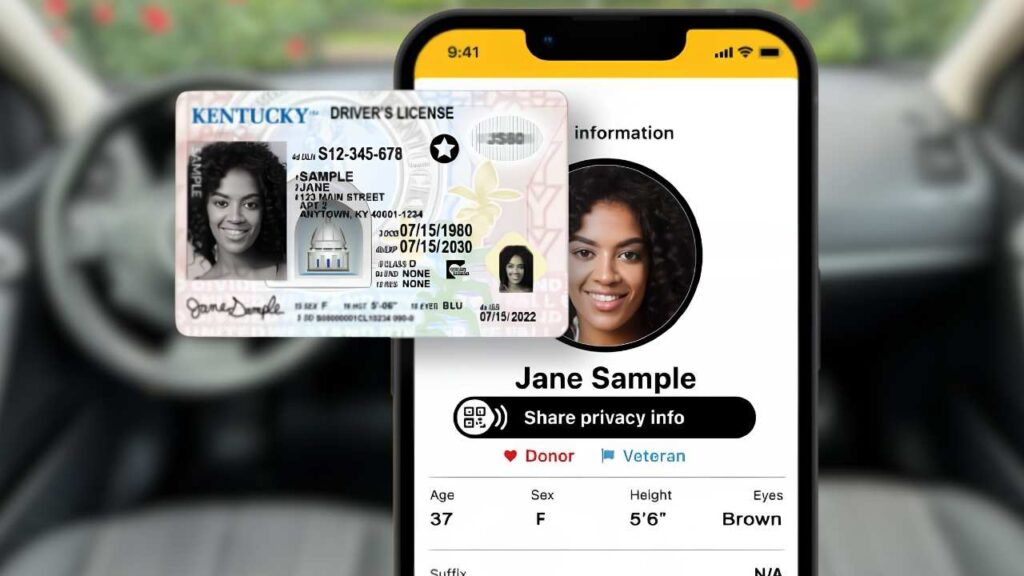
The state of Kentucky will announce in June the replacement of its driver’s license platform—which has been in place for nearly 40 years—with a completely new system called KINDL.
California, for its part, completed the update of its identity documents, incorporating a digital security signature that few states in the country have implemented thus far. Both decisions stem from distinct operational pressures but converge on the same goal: modernizing vehicle identification infrastructure.
Kentucky Closes Offices to Complete Data Migration
Kentucky Governor Andy Beshear introduced the initiative on April 15, 2026, as part of his regular “Team Kentucky” update. The announcement included specific transition dates and direct warnings to citizens about temporary service disruptions.
The scale of the process is not insignificant: the system must migrate more than 4 million driver records before it goes live. The myDrive portal, which accompanies the new system, will allow drivers to create personal accounts from which they can handle transactions without needing to appear in person at any office.
Features available at launch include license pre-application, requests for replacement cards, document status verification, and emergency contact registration. It will also enable payment of replacement fees and subscriptions to expiration reminders.
Kentucky to Close Its Offices Temporarily
To execute the migration, all regional license offices across the state will remain closed on June 4 and 5. Online renewal services will be suspended starting June 3 and will reactivate on June 8, when offices reopen with limited hours from 8 a.m. to 12 p.m., a schedule that will remain in effect until June 18.
Kentucky Transportation Cabinet Secretary Rebecca Goodman noted that approximately 55,000 Kentuckians have expirations during that month and urged them to take care of their business ahead of time. “Online and mail-in renewal is still an option for most Kentuckians who want to skip a trip entirely if they have a completed vision screening form,” the official stated.
What’s MyCDL portal
The new system also alters the administrative workflow for commercial drivers. Until now, medical certificates had to be submitted manually by the drivers themselves to the Federal Motor Carrier Safety Administration’s (FMCSA) National Registry. With KINDL, those certificates will arrive directly from authorized medical providers, eliminating that intermediate step. The MyCDL portal, which served as the certificate upload channel, will be discontinued.
In January 2026, Kentucky also launched the free Kentucky Mobile ID app, recognized as a valid document at security checkpoints in most airports across the country. During the 2026 legislative session, the General Assembly approved funding for three of the six new offices requested by the Transportation Cabinet. The new facilities will be located in Barren, Bullitt, and Oldham counties, though specific opening dates have yet to be set.
California Adds Digital Signature to Its Driver’s Licenses
While Kentucky prepares for its transition, California completed its own in October 2025. The state’s Department of Motor Vehicles (DMV) began issuing driver’s licenses and identification cards with a new design on the first of that month, featuring next-generation security elements.
The agency’s director, Steve Gordon, described the change in these terms: “The new cards use next generation technology to enhance security and with a design that shows California’s iconic redwoods, poppies and coastline.”
The most significant modification from a technical standpoint is the inclusion of a digital security signature within one of the two barcodes located on the back of the card. California thus becomes one of the first states in the nation to implement this type of technology on a physical identity document.
Simultaneously, the new cards eliminate the magnetic stripe from the back, a component that had been standard since 1990 when the state first began issuing licenses with that feature.
The last security update for California documents was in 2010, although a visual redesign tied to the implementation of the federal REAL ID was carried out in 2018. The new format requires no immediate action from cardholders: current licenses remain valid until their original expiration date, and the new design will be automatically issued upon renewal. Fees have not changed: a driver’s license remains $45, and an identification card is $39.