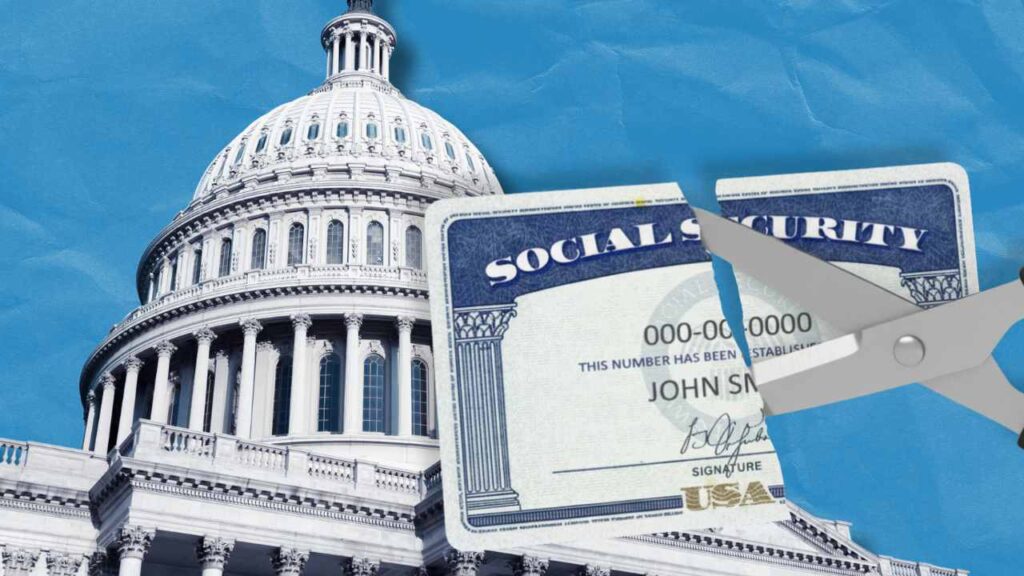
On May, a survey conducted in the United States found that 60% of retired workers rely on Social Security “exclusively or heavily” as their primary income source. That same month, the Congressional Budget Office released a concrete projection: the Social Security retirement trust fund will run dry in six years. Once that happens, benefits face an automatic 28% reduction.
If you are an American worker or retiree aiming at Social Security as your main income, you cannot afford to treat this as a distant political problem. The data is clear, the timeline is short, and the only rational response is to create a private backup plan.
Why inflation is hitting your Social Security
The Senior Citizens League, a non-governmental research group, calculated that despite several record-breaking cost-of-living adjustments (COLAs) in recent years, Social Security benefits have lost nearly 14% of their buying power over the last decade.
That means a retiree who received $1,500 per month in 2016 would need approximately $1,710 today just to buy the same goods and services. However, actual COLAs never fully closed that gap.
In 2027, the same organization predicts a COLA of 3.9%, which is higher than last month’s estimate of 2.8%. Many headlines will call this good news. It is not. A larger COLA simply confirms that inflation is surging. Historically, retirees end up with the short end of the stick because COLAs consistently lag behind real-time price increases in housing, healthcare, and groceries.
The 2026 CBO report changes everything
The Congressional Budget Office report, released weeks before the survey, states that the trust fund covering retirement benefits will be exhausted in six years. Without that trust fund, Social Security will only be able to pay benefits from ongoing payroll taxes, which currently cover roughly 72% of promised benefits. Hence the automatic 28% cut.
This is not speculation. It is the official projection from the non-partisan agency that Congress relies on for budgetary scoring. No current law prevents the cut. Lawmakers have debated solutions for years but have failed to pass legislation to replenish the trust fund. They’re running out of time before benefit cuts become a reality.
What this means for a 55-year-old worker today
If you are 55 today, you will reach full retirement age (67) in 2038 — about twelve years from now. The trust fund is projected to run dry in 2032. That means you would begin claiming benefits after the cut has already taken effect. Your promised $2,000 monthly check would actually be around $1,440. And because inflation will continue eroding buying power, that $1,440 will buy even less by the time you retire.
A 45-year-old faces an even larger gap. By 2046, the COLA shortfall alone could reduce real benefits by another 20% even before the 28% nominal cut. Combining both effects, a middle-income worker could see their effective Social Security income fall by 40% or more relative to today’s expectations.
Three concrete actions for a backup plan
- Calculate your real replacement rate: Use your latest Social Security statement and assume you will only receive 72% of the estimated benefit after 2032. Project your current retirement savings to age 90 using a 4% annual withdrawal rule. If the total falls below 70% of your pre-retirement income, you have a shortfall.
- Delay claiming if possible: The average retiree collects around $850 more per month at age 70 than at 62 — an extra $10,200 per year. This increase serves as a powerful hedge against the 28% cut. However, delaying only works if you have other savings or earned income to bridge the gap between early retirement and age 70.
- 3. Build a dedicated “buffer” account: Even saving an extra $100 per month into a taxable brokerage account or high-yield savings account over 15 years, with a modest 5% annual return, could grow to $26,000. That is not a fortune, but it can cover the difference between a reduced benefit and your actual expenses for several years. For a retiree facing a $400 monthly cut, a $26,000 buffer provides more than five years of protection.
The hard truth for current retirees
If you are already retired and Social Security provides the bulk of your income, your options are more limited. Part-time work or generating passive income can help, but not everyone can do so. In that case, the most important step is to lower your fixed expenses before the cuts arrive: pay off debt, downsize your home, or move to a lower-cost area. These changes are difficult, but far easier to make voluntarily than under the pressure of a sudden 28% income drop.