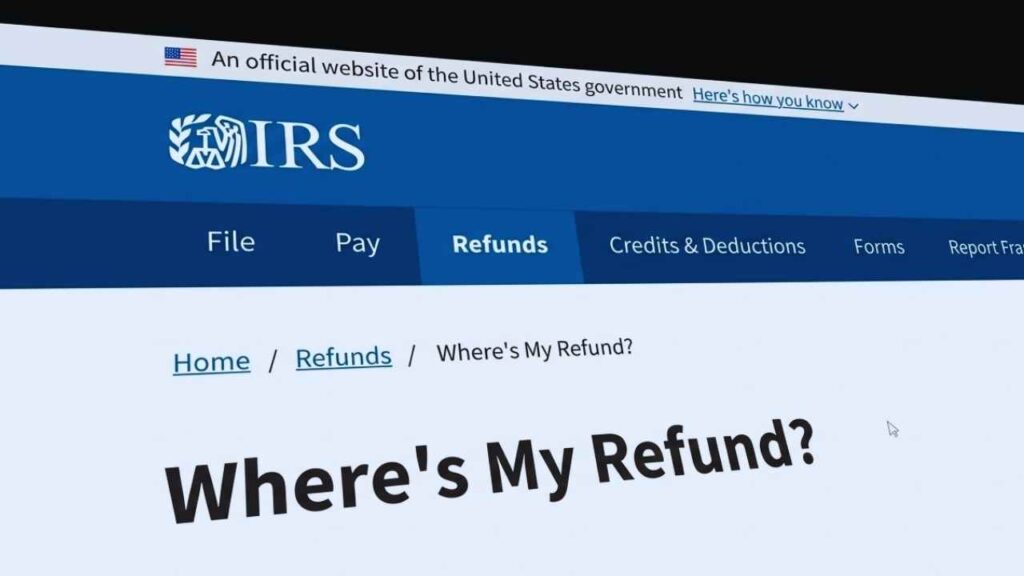
The Internal Revenue Service (IRS) has been operating since January 2026 under a new refund system that alters a process that functioned automatically for decades. The root of the change is Executive Order 14247, signed on March 25, 2025, under the title “Modernizing Payments To and From America’s Bank Account,.”
This legislation instructed the Treasury Department to halt the issuance of paper checks for federal payments—including tax refunds—no later than September 30, 2025. The 2026 filing season, which processes tax year 2025 returns, is the first to be run under that scheme on a widespread basis.
IRS Refund Freeze 2026: Avoid This Regular Mistake
The change does not alter the filing process itself. Taxpayers continue to complete the Form 1040 through the usual channels. What changes is the mechanism for delivering the money once the return is accepted and processed.
When a refund is approved but the return does not include valid bank details, the IRS does not issue a check immediately as it did before. Instead, it temporarily freezes the refund and initiates a phased notification process.
The central instrument of that process is the CP53E notice. A physical letter is sent to the taxpayer’s last registered address. The notice states that the refund is ready but cannot be released until direct deposit information is registered in the IRS online account.
From the date of the notice, the taxpayer has exactly 30 days to access their digital account at irs.gov and add or update their bank details. If the IRS successfully verifies the information, the refund will be issued via direct deposit. The CP53E notice is only issued once and cannot be handled by phone.
How to Set Up an IRS Online Account Before Your CP53E Notice Arrives
One relevant operational detail: CP53E is generated once per refund. If the initial direct deposit is rejected by the taxpayer’s financial institution, the IRS does not automatically issue a second notice or repeat the cycle.
Furthermore, IRS agents are expressly prohibited from registering banking information by telephone. The number included in the notice—866-325-4066—operates solely as an information line with recordings; it does not connect you to a representative or allow you to update your account information.
If the taxpayer takes no action within 30 days, the IRS will issue a paper check, but with a minimum delay of six weeks from the date of the notification. This period is added to the normal processing time for the return, significantly extending the total waiting time compared to previous seasons.
In contrast, returns sent by direct deposit with correct information from the time of filing are processed in less than 21 days in most cases, according to the IRS itself.
No Bank Account? The IRS Has a Plan
The Taxpayer Advocate Service (TAS), an independent agency within the IRS, published a guidance document on January 26, 2026, for taxpayers affected by this change. The document confirms that “the return will continue to be accepted and processed” even if banking information is not included, although it warns that “refunds may take longer to process” for those who do not provide this information and for whom no formal exception applies.
Taxpayers without bank accounts have alternative options enabled by the Treasury. The Treasury acknowledged in fact sheet FS-2026-02 that a segment of the population—estimated at around 4.2% of US households—does not have access to traditional banking services. For this group, the government has enabled alternative channels:
- Prepaid debit cards approved by the IRS
- Resources to open low-cost or no-cost accounts in coordination with the FDIC, NCUA, and US Bank.
The Treasury also indicated that formal exceptions to the electronic payment requirement will be limited and reserved for documented cases of inability to access the funds.
Form 8888 Was Removed From the Filing Process
The economic justification the government cites for the change rests on three arguments: security, cost, and speed. A Treasury report indicates that paper checks are 16 times more likely to be lost, stolen, altered, or delayed than electronic payments.
In budgetary terms, the federal government allocated more than $657 million during fiscal year 2024 to maintain the paper check infrastructure, including physical processing and lockbox services. The phase-out of this system aims to reduce this expenditure.
The mechanics of the change also involve the Form 8888. The IRS, which historically allowed taxpayers to split their refund among multiple accounts or request a check, removed that option from the form for the 2026 tax season, eliminating one of the channels some taxpayers used to explicitly opt for a physical refund.
The IRS clarified that it will continue to accept paper checks as a method of payment to the government while the transition progresses, although that route will also be gradually reduced.
Opt for Electronically Filing Your Taxes
Electronic submission remains the method with the least exposure to delays. The Form 1040 includes a section to record the routing number and bank account number at the time of filing.
Tax software platforms—including TurboTax, H&R Block, and IRS Free File—generate alerts when this information is missing. Tax professionals and consulting firms like KPMG have noted that the 2026 tax season presents additional uncertainties for certain groups, including international contributors and employees on cross-border assignments, given that the definition of “international taxpayer” has not been clarified in the guidance documents issued so far, leaving open the question of whether they are exempt from the new process or not.
Those who claim the Earned Income Tax Credit (EITC) or the Additional Child Tax Credit (ACTC) also face a separate restriction: the PATH Act of 2015 prohibits the IRS from issuing those refunds before mid-February, regardless of the payment method.