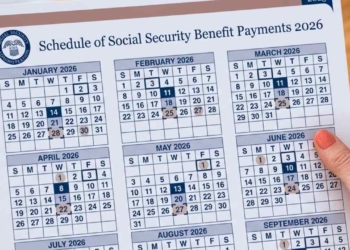

As the country prepares to close out 2025, nearly 7.5 million of the most vulnerable Americans will receive a year-end gift that isn’t a bonus, but a crucial advance: their Supplemental Security Income (SSI) payment for January 2026, credited on Wednesday, December 31.
This move, which at first glance appears to be an accounting anomaly, is actually an established protocol designed to protect beneficiaries from starting the year without funds, and this cycle includes an increase in the amount to reflect persistent inflation.


Why Your January SSI Check is Coming on New Year’s Eve 2025
This isn’t extraordinary generosity, but rather an unbreakable administrative rule. The Social Security Administration (SSA) doesn’t process payments on weekends or federal holidays. When the first day of a month falls on one of these non-business days, the agency moves the payment to the last preceding business day. January 1, 2026, is a federal holiday.
For this reason, the payment for that month will arrive in accounts on Wednesday, December 31, 2025. This means that those who receiveonlySSIs will see two deposits in December: the one corresponding to December, which is paid on the 1st, and the one for January, paid in advance on the 31st. The SSA is emphatic in clarifying that this is not extra money, but a rescheduling that requires careful financial planning so that those funds last through the month of January.
The 2.8% COLA Increase: New SSI Benefits for 2026
That advance payment on December 31 will have a special significance: it will be the first to include the Cost of Living Adjustment (COLA) for 2026, set at 2.8%.
This automatic adjustment, calculated based on the Consumer Price Index for Urban Wage Earners and Clerical Workers (CPI-W), will affect approximately 75 million people who receive Social Security or SSI benefits.
For SSI beneficiaries, the increase raises the maximum federal payment amount. An eligible individual will see their monthly benefit increase from $967 to $994, while an eligible couple will see their standard benefit rise from $1,450 to $1,491.
Dual Eligibility: When Retirement Is Not Enough
A common but poorly understood scenario is that of citizens who receive Social Security retirement benefits and also qualify for SSI benefits. This is not only possible, but the Social Security Administration (SSA) includes it in its statistics. The major issue lies in the strict income and resource limits of the SSI program.
To be eligible for SSI, a person must be 65 or older, blind or disabled, and meet citizenship and residency requirements. The determining factor for those already receiving a pension is financial limits. The program considers “income” to include not only money earned from work but also benefits received from other sources, such as Social Security.
If the pension amount, plus other income, falls below the federal SSI payment standard ($994 for an individual in 2026, as explained above), and the person also has very limited resources (no more than $2,000 for an individual), they may qualify for a supplemental SSI payment that brings their total income up to that level.
Payment Schedule for Dual Beneficiaries
For people who receive both Social Security benefits (retirement or disability) and SSI, the payment schedule follows a different, priority rule. Their combined payment—the sum of both benefits—arrives on a single date each month, and this date is governed by the Social Security payment schedule, not the SSI schedule.
According to the published schedule, these dual beneficiaries, along with those who began receiving benefits before May 1997, will receive their funds on December 3, 2025 (a Wednesday) for that month’s payment.
Have into consideration that they do not receive a “double payment” in December, as their December 3 deposit is the only one they will receive that month.