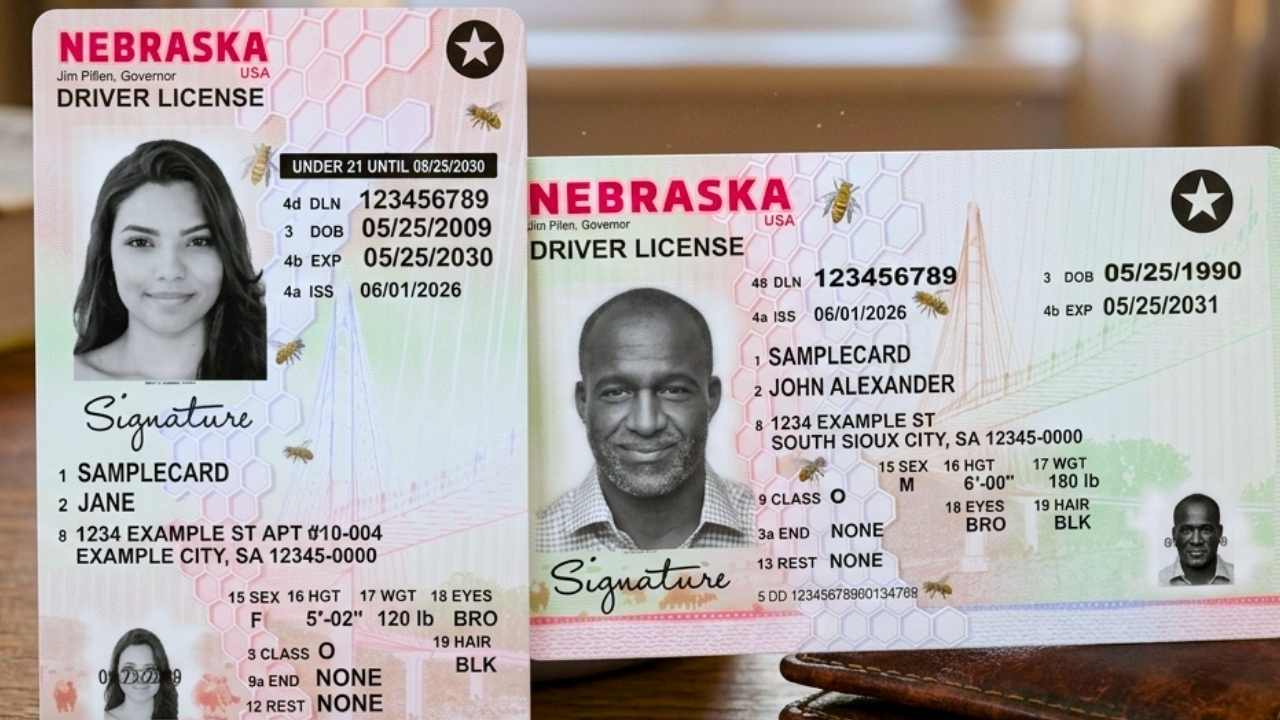
Nebraska quietly changed something that millions of its residents carry in their pockets every single day without giving it much thought. The state’s Department of Motor Vehicles (DMV) announced Monday the launch of a redesigned driver’s license and state ID card.
It’s an overhaul that arrives loaded with local symbolism but driven by a more urgent logic: protecting personal identity at a time when document fraud shows no signs of slowing down and driver’s licenses are also attacked by criminals.
A New Look Rooted in Nebraska’s Driver’s License, State ID
The announcement came out of Lincoln and spread quickly across the state. The new credential retires a design that had been in use for roughly five and a half years, replacing it with updated aesthetics that lean hard into Nebraska’s character.
The Bob Kerrey Pedestrian Bridge in Omaha, cattle grazing on open prairie, wheat fields, the honeybee — the state’s official insect — and the Wildcat Hills in Nebraska’s far western corner are the images now woven into the card. None of those choices were accidental.
Each symbol was picked to capture the geographic, economic and cultural range of a state that rarely makes national headlines but carries a distinct identity all its own.
The Black-And-White Photo on Nebraska’s New Driver’s License
The visual refresh, though, is just the most obvious layer of what this document represents. The most striking technical change is the shift to black-and-white photography for the cardholder’s image — a decision the DMV backs with concrete reasoning.
Monochromatic photos, the agency explained, make it easier to distinguish facial features by emphasizing bone structure, lighting and texture over color. That matters in practical terms: for law enforcement officers running roadside checks, for bars and liquor stores verifying age, for banks and airports confirming who’s standing in front of them.
DMV Director Rhonda Lahm was straightforward about the thinking behind the redesign. “We want to make sure it doesn’t become too stale so we can stay ahead of those trying to create counterfeits,” Lahm said. She acknowledged that the cycle of updating official documents is driven precisely by that pressure — every so often, those looking to illegally reproduce these credentials get close enough to the real thing to pose a genuine risk. When that happens, it’s time to move.
“These new driver’s licenses and state identification cards celebrate the people, industry, and landscapes that define Nebraska, while incorporating the most up-to-date security features available,” Lahm said in the official statement. “The addition of monochromatic photographs and enhanced security features further strengthens our ability to protect the identities of Nebraskans.”
The Driver’s License Security Layers You Can’t See
Beyond the photo, the new document packs in the latest anti-counterfeiting technology, refined microprinting and additional security elements embedded directly into the card material — layers that are nearly invisible to the naked eye but prove decisive when someone needs to detect a fake.
The credential was developed in partnership with Idemia, a company specializing in digital identity solutions and secure documents that operates across dozens of countries.
On the rollout timeline, the DMV will begin issuing the new licenses and IDs at select locations this month. By mid-April, every driver’s license service center across Nebraska will be putting out the new design. Cheryl Porter, administrator of the Driver Licensing Services Division, made a point of clarifying something residents will want to know.
“Cards with the prior design will remain valid for all official purposes until they reach their expiration date,” Porter said. “Customers should renew or replace their credential only when they would otherwise be required to do so.”
Nobody needs to rush to the DMV. The transition will be gradual, unfolding naturally as current documents expire and their holders come in for renewals. The state is not imposing any early deadlines or additional fees tied to the design change.