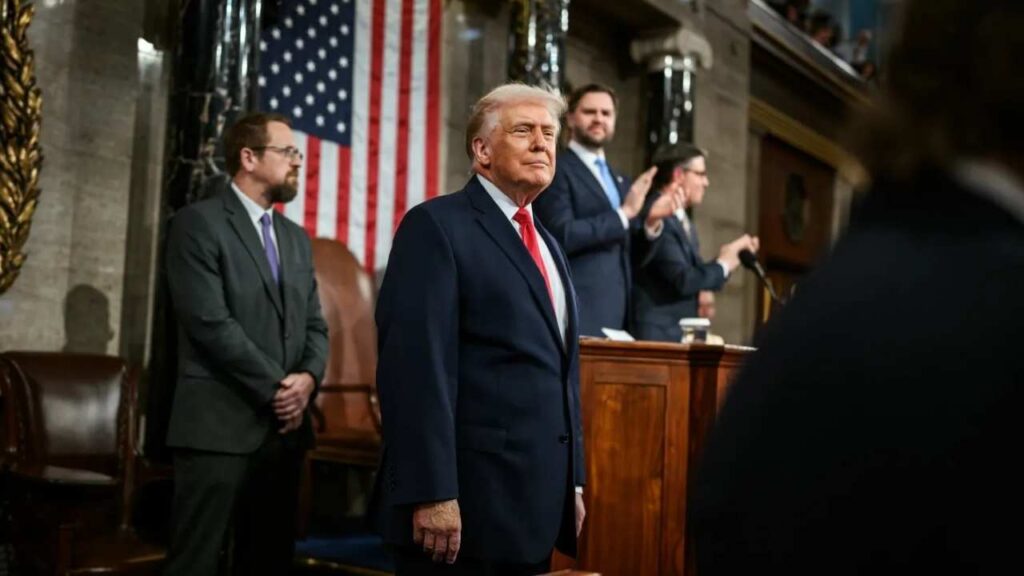
It was a State of the Union address that clocked in at nearly two hours, a marathon of promises and political theater. But buried beneath the familiar rhetorical flourishes on immigration and foreign policy, President Donald Trump dropped a policy grenade that has retirement policy experts—and a whole lot of working Americans—scrambling for the fine print.
During his address on Tuesday night, Trump unveiled a plan to offer a government-matched retirement account to the roughly 50 million Americans currently languishing in the private-sector pension desert. The proposal is audacious in its simplicity and politically potent: give workers who lack a 401(k) the same deal as federal employees, and throw in up to a grand of free money to get them to play ball.
That $1,000 Retirement Match Sounds Great: Here Are the Facts
“Half of all of working Americans still do not have access to a retirement plan with matching contributions from an employer,” Trump stated from the dais. “To remedy this gross disparity, I’m announcing that next year my administration will give these often-forgotten American workers access to the same type of retirement plan offered to every federal worker. We will match your contribution with up to $1,000 each year.”
On the surface, it sounds like a silver bullet for the nation’s looming retirement crisis. But as with any political Hail Mary passed during a primetime address, the devil is not just in the details—it’s in the fact that the details are largely missing.
The “Forgotten Workers” Get a Wall Street Invite
According to a White House official who spoke with news media, the model is the Thrift Savings Plan (TSP), the low-fee, index-fund heavy plan used by federal employees and members of Congress. The idea is to lower the barrier to entry.
Instead of navigating the confusing waters of opening an Individual Retirement Account (IRA) on their own, workers would ostensibly check a box on their tax returns to opt-in. The government would then sweeten the pot, matching contributions up to $1,000 annually.
Teresa Ghilarducci, a labor economist at The New School who specializes in retirement security, sees the move as a landmark shift in thinking, even if the mechanics are still fuzzy. Ghilarducci is familiar with the plan’s genesis, having worked on an early iteration of this concept with White House economic adviser Kevin Hassett back in 2021.
“This is a big deal,” Ghilarducci said. “It finally recognizes that most people don’t have anything saved for retirement, and they don’t save consistently.” She added that the proposal represents a rare point of convergence in a fractured political landscape. “The idea was to get someone far on the right and far on the left to come together.”
The Fine Print on That $1,000 Government Retirement Payment
The White House is framing this as the next logical step in its “populist capitalism” agenda, a sequel of sorts to the recently proposed “Trump accounts” for children, which aimed to give minors a stake in the markets. The administration is betting that direct financial incentive—a government match—will turn a generation of renters into investors.
But the applause lines in the House chamber mask a labyrinth of logistical hurdles. For one, the White House cannot simply wave a wand and create this system. While it builds on the scaffolding of the SECURE 2.0 Act—a piece of legislation passed under former President Joe Biden that updates rules from Trump’s first term—expanding it to this scale requires congressional approval.
Treasury Secretary Scott Bessent has hinted that the administration might try to jam it through via budget reconciliation to avoid a filibuster (vote of no confidence).
The SOTU Promise That Has Retirement Experts on Edge
Furthermore, the economics of the match raise questions. Funding the program for 50 million potential savers, even if only a fraction enroll, represents a significant outlay. And while the match is designed to encourage saving, critics warn that it could simply shift money from other savings vehicles or prove too small to move the needle for those living paycheck to paycheck.
Then there is the elephant in the room that no SOTU applause line can fix: Social Security. The trust fund is projected to run dry in 2033. If Congress fails to act, retirees—even those with shiny new TSP accounts—face a steep, automatic cut to their benefits. Ghilarducci acknowledged that this new account is not a panacea. “There’s still more to be done,” she said.