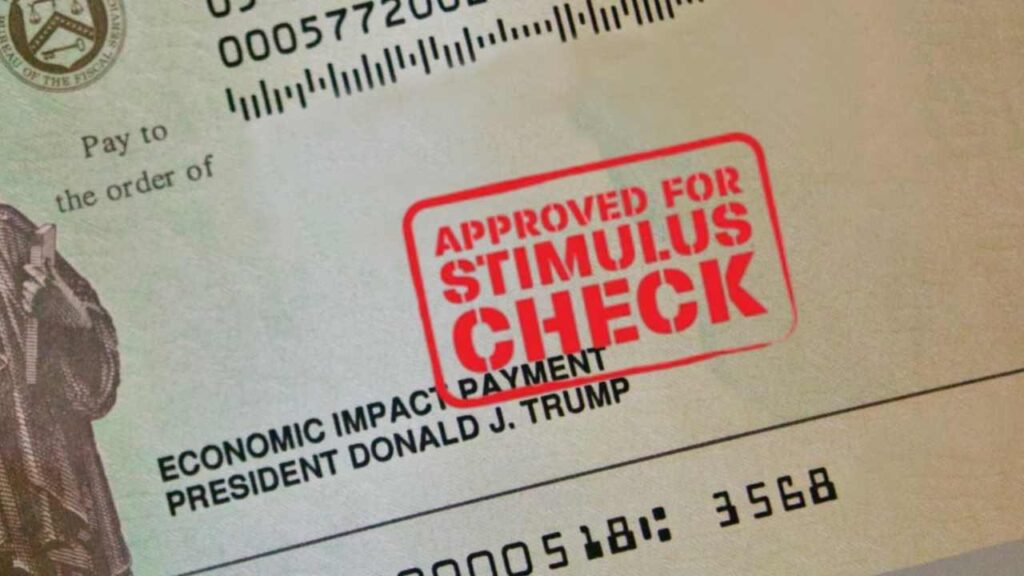
We all like some extra money, a stimulus check to invest, spend, or pay off debts. Certain proposals resurface with the force of a campaign slogan, challenging the complex machinery of Washington. One of them is the idea, revived by President Donald Trump, of funding $2,000 direct stimulus checks for millions of citizens using exclusively the revenue from import tariffs.
Identified as the “tariff dividend,” this stimulus check initiative is presented as a circular mechanism of economic policy: the money raised by protective tariffs goes directly back into the pockets of Americans who, according to the presidential narrative, need it most and who have borne the brunt of unfair international competition.
What Is the Status of Trump’s Stimulus Checks?
The proposal, however, remains, as of February 2026, in the realm of discussion and promise, but all is not lost: if certain characteristics are aligned, it could materialize at some point in 2026.
Its journey from political rhetoric to tangible reality is fraught with fundamental obstacles that experts in fiscal policy, constitutional law, and international trade view with skepticism. Trump initially introduced it in November 2025, arguing that it would strengthen the national economy and compensate citizens.
According to the president, these payments would not only serve as financial relief but also demonstrate the benefits of his tariffs, which he describes as a tool to protect American industries and reduce the deficit.
The Secret Conditions for $2,000 Checks to Become Reality
The first and most basic obstacle is purely arithmetic. The plan’s viability hinges on tariff revenue being sufficient to cover massive outlays. Trump has claimed the government has raised “hundreds of millions of dollars,” even citing figures exceeding $600 billion.
However, independent analyses paint a more austere picture. The Tax Foundation, a Washington-based think tank, estimates tariff revenues for 2026 at around $207.5 billion. Against this figure, projected costs for universal payments—excluding high-income earners—range from $279.8 billion to $606.8 billion.
The gap is clear. This presents a dilemma: either tariffs are significantly expanded, the plan must be radically more restrictive in its scope, or it will ultimately be financed by increasing the deficit, contradicting one of its supposed pillars.
“Free” Money to Claim? The Truth Behind the Big Promise
Most scholars of budget law and historical precedents—such as the massive bailouts and stimulus packages during the COVID-19 pandemic—point out that a distribution of funds of this nature requires congressional approval. Economic advisors to Trump himself, such as Kevin Hassett, have indicated that a formal proposal would be submitted to Congress.
However, in recent statements, the president has hinted at an alternative route, suggesting that legislative approval might not be necessary by citing unspecified “other sources” of funding.
Other Stimulus Checks Ideas: Up to $2,400 Proposed
This ambiguity creates legal and political uncertainty, especially since figures within the president’s own party have unsuccessfully attempted to promote similar ideas. A bill introduced by Senator Josh Hawley in July 2025 proposed checks ranging from $600 to $2,400 per family, but it never reached a vote.
The uncertainty extends to the judicial sphere… yes, I’m sorry, friend: it’s the separation of powers, and it’s part of democracy. The very tariff structure that would fund this “dividend” faces an existential challenge before the Supreme Court.
An imminent ruling on the constitutionality of the tariffs imposed by Trump during his first term could potentially invalidate or limit the revenue-generating mechanism. If the court rules against the executive authority to impose these tariffs without explicit congressional delegation, the promised source of funding could evaporate or be drastically reduced, leaving the plan without a foundation.
How Could the Government Assign These Stimulus Checks?
Finally, there are logistical and credibility challenges. The administration would have to define and implement precise eligibility criteria. Based on statements from Trump and officials like Treasury Secretary Scott Bessent, the checks would be limited to individuals with incomes up to $75,000 annually or couples up to $150,000, excluding “high-income individuals.”
The task would fall to the IRS, an agency with experience in pandemic stimulus but which has also faced criticism for delays and fraud. In fact, the atmosphere of anticipation has already created fertile ground for scammers, with reports of fraudulent emails promising imminent payments in exchange for personal information.