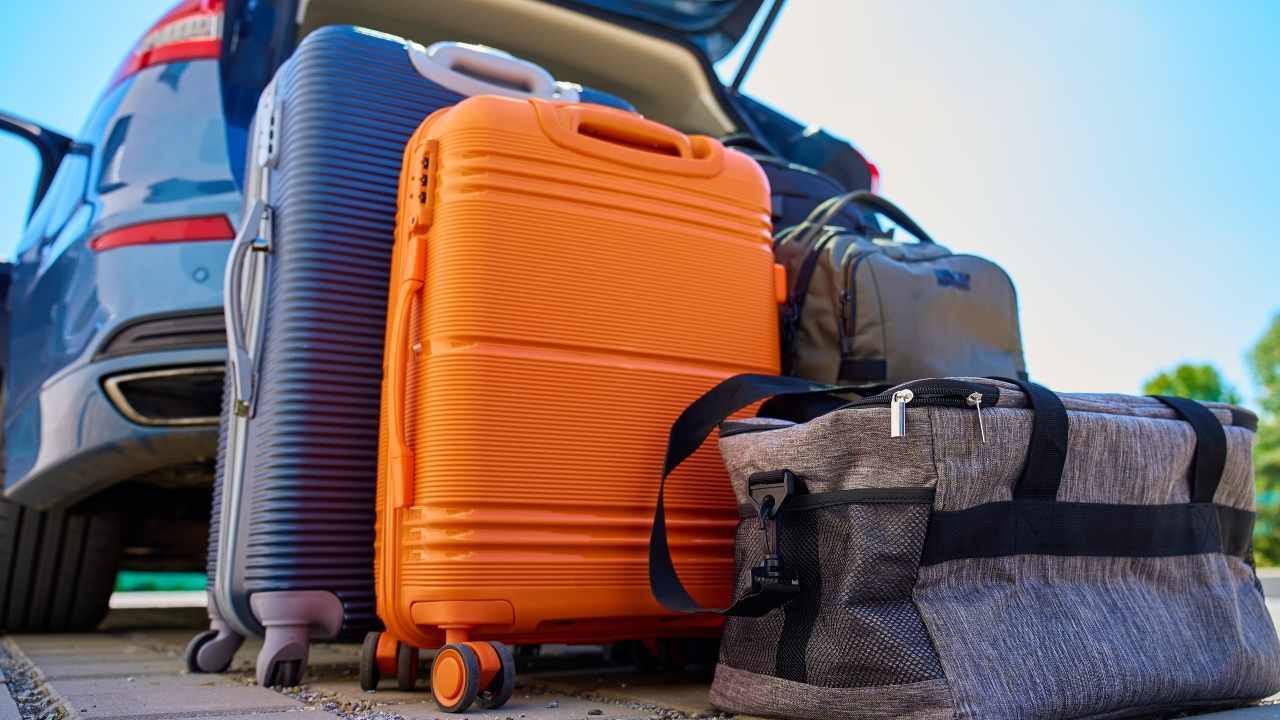
Imagine arriving at the airport with just enough time, after a race against the clock to pack everything needed for a trip. You approach the check-in counter and place your luggage there. You put it on the scale, and suddenly, the front desk personnel informs you that your belongings exceed the permitted dimensions or weight.
Dear God… what do we do now? This unexpected notification forces you to reorganize your contents on the spot, pay additional fees, or even leave essential items behind, transforming what should be the start of an adventure into a moment of logistical stress.


Avoid Airport Baggage Shock: The Airline with the Most Forgiving Rules
An overview of regulations updated through 2026 reveals differences in size, weight, and application, affected by trends such as the increase in measurements at boarding gates.
Among the available options, Southwest Airlines ranks as the one with the most permissive rules in terms of dimensions and enforcement:
Variations in Baggage Policies
For checked baggage, Southwest maintains a linear limit of 62 inches (158 centimeters) and 50 pounds (23 kilograms), with fees of $35 for the first bag and $45 for the second. Passenger experience reviews posted online indicate less stringent enforcement, with fewer rejections for marginal overweight baggage compared to other airlines. This approach contrasts with the general tightening across the industry during 2026, where scanners and precise measurements have become standardized.
In comparison, American Airlines sets:
- Carry-on dimensions: American Airlines sets a carry-on size of 22 x 14 x 9 inches, with no weight restriction.
- Personal item: The personal item allowance is 18 x 14 x 8 inches.
- Checked baggage: Checked baggage follows the industry standard of a 62-inch linear limit and 50 pounds.
- Checked bag fee: The first checked bag fee ranges from $35 to $40.
A notable change between 2025 and 2026 was the removal of fixed gate measuring devices, shifting enforcement decisions to agents and potentially introducing more variability.
Is Your Backpack a “Personal Item” or a “Carry-On”?
Delta Air Lines aligns its measures hand luggage measuring 22 x 14 x 9 inches, describing the personal article like something that fits under the seat, similar to a purse or backpack. The rates for checked they cost $35 for the first and $45 for the second, with enforcement intensifying on high-occupancy flights, where incompatible bags can be redirected at no additional cost in certain cases.
United Airlines applies the same base dimensions for the hand luggage; however, it incorporates restrictions on basic economic tariffs that limit options. Personal article is set at 17 x 10 x 9 inches, and the use of automated scanners by 2026 reduces human discretion, making the process more predictable but less flexible. Standard rates for checked they remain at $35 and $45.
For their part, Alaska Airlines does not specify exact measurements for the personal article beyond the fact that it must fit under the seat, while the hand luggage it measures 22 x 14 x 9 inches. It offers discounts for early payments invoiced, with identical limits to the rest and fees of $35 to $40 for the first bag.
JetBlue stipulates a personal article measuring 17 x 13 x 8 inches, and fares vary depending on the ticket class, reaching up to $65 for the second bag during peak periods. In basic categories, restrictions apply to hand luggage , aligning with a more controlled approach.