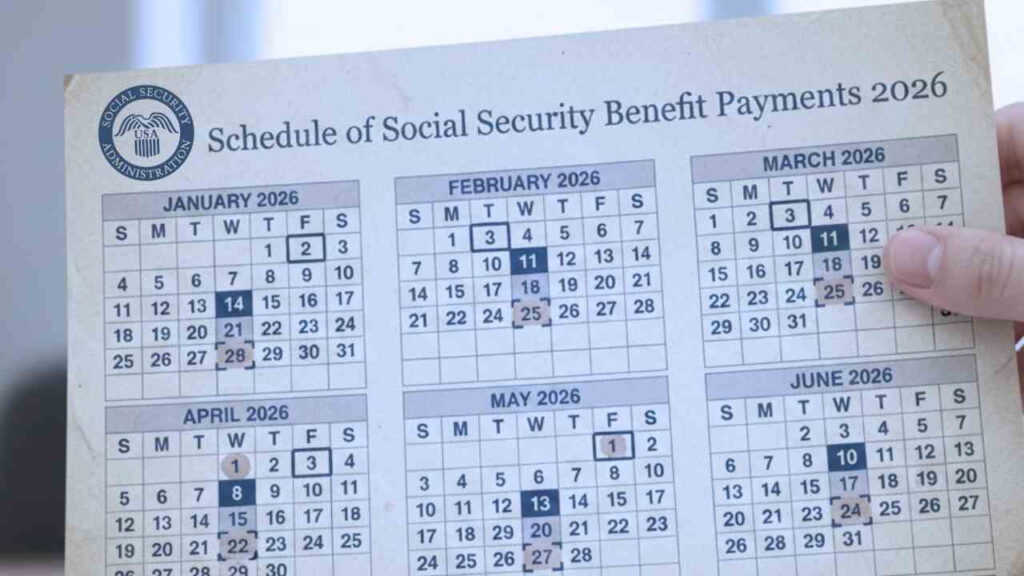
In the machinery of the U.S. Social Security system, where over 70 million beneficiaries await their monthly payments, February 2026 is what all of them await: fresh, new money is coming to their bank accounts. On Tuesday, February 3, a specific cohort will receive their funds, while the majority will watch their calendars for a Wednesday later in the month.
The individuals who qualify for that earliest February date are not determined by their birthdate, but by a single factor: they are retirees, survivors, or disability beneficiaries who started receiving their benefits before May 1997.
A Group Gets Paid First Every Month From Social Security
According to the Social Security Administration’s payment schedule, for those who received benefits before May 1997, your payment is sent on the third day of the month. This group runs on a fixed monthly schedule, largely untouched by the modern system that organizes everyone else. For February 2026, that third day falls on a Tuesday.
Who are they? They are the longest-standing beneficiaries in the system. To have been on the rolls before May 1997 means they have been receiving benefits for at least 28 years by 2026.
They are individuals who retired, became disabled, or qualified as survivors in a different era. The policy change that created this two-track system was implemented to stagger payments and improve administrative efficiency.
The SSA states the change was made “to better manage our workload and serve you.” For the pre-May 1997 group, however, their payment timing was grandfathered in, creating a permanent, if shrinking, class within the beneficiary population.
How Many of These Pre-1997 Beneficiaries Remain?
Concrete, published data is elusive. The Social Security Administration publishes vast annual datasets but does not break down its monthly beneficiary counts by the specific “pre-May 1997” criterion in public fact sheets. We can infer their numbers are declining with time.
With roughly 70 million total beneficiaries today, this group represents a segment of the oldest recipients. Their continued existence is a footnote to a policy shift now nearly three decades old, a human timeline of the program’s evolution.
Post-1997 Social Security Recipients’s Dates
For the vast majority of beneficiaries—those whose claims were approved in May 1997 or later—February 2026 follows the now-standard rhythm. Their payments are tied to their birthdates and spread across the month’s Wednesdays.
For that February, the schedule is clear: those born between the 1st and 10th will be paid on the second Wednesday, February 11. Those born between the 11th and 20th receive funds on the third Wednesday, February 18. Anyone with a birthday between the 21st and 31st waits until the fourth Wednesday, February 25.
Maximum Benefits in 2026
You might find it surprising how much those few extra years can really pay off when you look at the maximum possible Social Security benefit for February 2026. The Social Security Administration itself puts the top numbers at $2,969 a month if you start at age 62, $4,152 if you wait until your exact full retirement age, and a substantial $5,181 for those who can hold off until age 70.
This gigantic jump of over $2,200 a month just for waiting those eight years really shows the power of delayed credits, especially for someone who’s managed to hit the maximum taxable earnings cap for their whole career.
Of course, to even be in the running for these top-tier checks, you’d have had to earn at or above the Social Security wage base, which is a hefty $184,500 for 2026, for most of your working life.