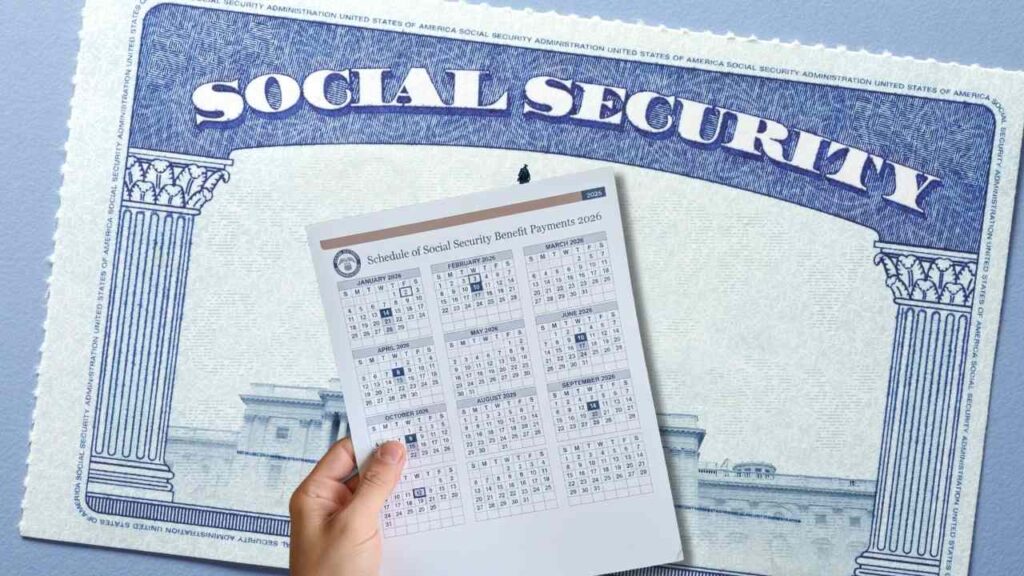
As more than 70 million Americans prepare to receive their Social Security deposits this February, temporary tax relief promised by recent legislation clashes with the stark reality of persistent inflation and a trust fund whose countdown continues its relentless ticking.
The implementation of the One Big Beautiful Bill Act (OBBBA), combined with the 2.8% Cost of Living Adjustment (COLA) for 2026, paints a picture of immediate relief for many retirees, but exposes the deep, unresolved gap in the system.
First, Let’s See February’s Social Security Dates
The February payment schedule is set to proceed with the usual punctuality. Supplemental Security Income (SSI) recipients will receive their payment on Friday, January 30, early because January 1 falls on a Sunday.
Those who retired before May 1997, as well as those receiving both SSI and Social Security benefits concurrently, will be paid on Tuesday, February 3. For everyone else, the disbursement will be staggered according to birthdate:
- those born between the 1st and 10th will receive it on Wednesday the 11th;
- those from the 11th to the 20th, on Wednesday the 18th;
- and those from the 21st to the 31st, on Wednesday the 25th.
The Maximum Social Security Benefits to Expect
This raises the maximum theoretical amount for a retiree at age 70 to approximately $5,181 per month, while the average beneficiary will receive about $2,071. However, the nominal increase is immediately eroded.
The Medicare Board of Trustees announced last November a 9.7% increase in Part B premiums for 2026, a hike that eats up a substantial portion of the inflation adjustment. “The COLA should be a shield against the loss of purchasing power, not an abstract number that disappears into mandatory expenses,” said a spokesperson for the American Association of Retired Persons (AARP), who asked not to be identified.
Those who claim SSI could expect a maximum of $994 for an individual, and up to $1,491 for a couple receiving the benefits together. For an essential person assisting a disabled beneficiary, the cap is set to $498 a month.
The OBBBA Changes Over the SSA Benefits
It is in this context that the OBBBA, signed into law last year, attempts to make a tangible difference for older taxpayers. Its cornerstone is an additional $6,000 tax deduction for individuals 65 and older ($12,000 for couples filing jointly), effective from tax year 2025 through 2028.
However, the devil is in the details, and in this case, in the steps for phasing in the deduction. The deduction begins to be phased out for individual incomes above $75,000 and for combined incomes above $150,000, disappearing completely above $175,000 and $250,000, respectively.
The “Short-Term Fix” That Has Retirement Experts Worried
This structure has drawn criticism from both sides of the political spectrum. Conservative analysts argue that the measure, not being accompanied by new revenue, further weakens the trust fund’s solvency. “It’s a short-term fix that will lead to long-term problems. They’re giving away deductions that reduce overall tax revenue, while the clock keeps ticking on the fund’s depletion in 2033,” said Michael Thompson, from the Center for Budget Policy, a Washington-based think tank.
From the opposing viewpoint, critics point to the measure’s inadequacy for the most vulnerable. “For a retiree who depends solely on Social Security and a small pension, it’s likely they would no longer pay taxes on those benefits. This deduction is irrelevant to them. The real problem is the inadequacy of the base benefit compared to the cost of housing and medications,” explained economist Claudia Reynolds of the Coalition for Economic Justice.
Reynolds added that the complexity of the elimination brackets creates uncertainty. “Many older taxpayers won’t know for sure if they qualify or to what extent, which could lead to unpleasant surprises when filing their tax returns.”
Public policy experts agree that the OBBBA, while well-intentioned, is a temporary fix that avoids the fundamental debate. The law makes no changes to payroll taxes, does not modify the full retirement age, and does not address long-term sustainability. It simply uses the general tax code to temporarily and selectively subsidize retirees’ incomes, without touching the architecture of the Social Security program.