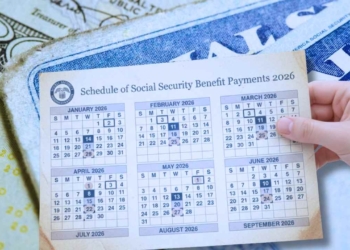

The national banking system will process transfers corresponding to a significant portion of Social Security Disability Insurance (SSDI) beneficiaries during the third and fourth weeks of April 2026. The exact dates of those electronic movements fall on April 15 and April 22.
The assignment of each individual to one of these two days does not stem from any administrative procedure or the amount of the benefit received. It is drawn directly from the numerical day of their birth date, as outlined in the SSA official 2026 Payment Calendar.
Every Month, SSDI Benefits Go Out in Three Different Dates
SSDI payments are distributed in three monthly batches corresponding to the second, third, and fourth Wednesdays of the month. Beneficiaries who are not included in the April 15 and April 22 dates—either because they were born in the first ten days of the month or because they receive combined payments with Supplemental Security Income.
They had already seen their deposit reflected in the first half of the period. Information regarding these cycles is consolidated in the operational records of the Social Security Administration with no room for subjective variation.
April’s Full Calendar for SSDI Benefits
| Payment Date | Day of Week | Beneficiary Birth Date Range |
|---|---|---|
| April 8, 2026 | Second Wednesday | Born 1st – 10th of any month |
| April 15, 2026 | Third Wednesday | Born 11th – 20th of any month |
| April 22, 2026 | Fourth Wednesday | Born 21st – 31st of any month |
Note: The schedule applies to SSDI payments. Those receiving Supplemental Security Income (SSI) or combined benefits follow a different calendar.
What’s the Top Disability Benefit Amount in April?
The Social Security Disability Insurance program has an upper limit on what any individual can receive, and for 2026 that figure lands at $4,152 per month. It’s a number that shows up in headlines, but it’s worth understanding that this isn’t some arbitrary cap.
It’s a direct function of what a person earned during their working life, specifically the years they paid Social Security taxes at the maximum taxable level.
Hitting that $4,152 monthly amount requires a very specific earnings history. The SSA calculates benefits using a formula based on a worker’s Average Indexed Monthly Earnings (AIME) over their highest-earning 35 years.
To get the maximum, a person would have needed to earn at or above the contribution and benefit base—the maximum amount of earnings subject to Social Security tax—for at least 35 years. For context, that taxable earnings base climbed to $184,500 for 2026. A lot of people never hit that mark in a given year, let alone for three and a half decades straight.
What About the Average SSDI Deposit?
The SSA reports that the estimated average monthly benefit for a disabled worker in 2026 is $1,630. This is the figure that provides a more realistic benchmark for what the program delivers to most of its beneficiaries.
This average is the result of the 2.8% cost-of-living adjustment that took effect in January 2026 for SSDI and every type of benefit managed by the SSA: