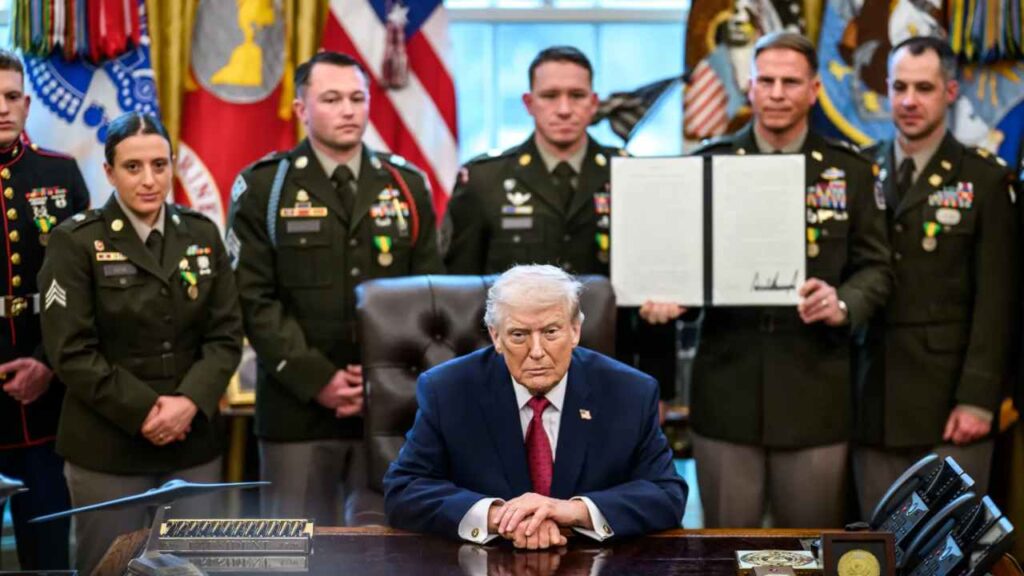
In a prime-time address dripping with the theatricality of a game show host, President Donald Trump unveiled what he pitched as a grand, patriotic gift to the nation’s warriors: a stimulus check just for them, calling them “warriors”.
“We are sending every soldier $1,776 – and the checks are already on the way. Nobody deserves it more than our military,” Trump declared, brandishing the sum tied to the year of America’s founding as a “warrior dividend” expressed as a stimulus check initiative.
The announcement, targeting 1.45 million service members at a cost of roughly $2.5 billion, was presented as a direct result of his economic stewardship. “Because of tariffs,” he stated, alongside his recent tax-and-spend bill, “we made a lot more money than anybody thought.”
Trump’s $1,776 Military Bonus: What We Know So Far
But within 24 hours, the gleaming narrative began to tarnish under the scrutiny of fiscal reality. According to a senior administration official who spoke to the Washington Post on condition of anonymity, the payments are not, in fact, being conjured from a surplus of tariff revenue as the President implied.
Instead, the funds are being repurposed from existing military housing assistance allocations that were previously approved by Congress as part of the recent omnibus spending package, the One Big Beautiful Bill Act (OBBBA).
This revelation strips the announcement of its purported significance and reframes it as a reallocation of already-appropriated defense dollars, raising immediate questions about transparency and priorities. The move comes at a time when military families continue to grapple with longstanding issues regarding the quality and maintenance of on-base housing, the very area from which these funds are reportedly being diverted.
Who’s Eligible for the “Warrior Dividend”
The primary beneficiaries are active-duty members of the U.S. Armed Forces, including the Army, Navy, Air Force, Marines, and Coast Guard. According to details provided by the Department of Defense and Secretary Pete Hegseth, the bonus is intended for personnel from the lowest ranks (E-1, such as privates or recruits) to senior officers (up to O-6, equivalent to colonel or captain).
Some eligible reservists may qualify if they are on active duty, but it does not include retired veterans, inactive National Guard members, or civilian Department of Defense personnel. The goal is to recognize the service of those currently serving.
How Will the “Warrior Dividend” Disbursement Be
As for the payment, it’s a one-time disbursement that, according to Trump, “is already on its way” and will arrive before Christmas (possibly before December 25, 2025). It will be distributed primarily via direct deposit into bank accounts linked to the military pay system (through DFAS, Defense Finance and Accounting Service), similar to how they receive their regular pay. In exceptional cases, it could be sent by physical check.
Sources indicate the bonus could be tax-free (according to statements by Hegseth), although there were initial doubts about this. The funding comes from funds already approved by Congress for military housing subsidies, reallocated for this purpose, and not from new tariff revenue as the president initially suggested. If you are an active-duty service member, you don’t need to apply; it will be processed automatically.