
The year 2025 is about to a close, rumors about a new round of federal stimulus checks continue to swirl online. However, no law authorizing stimulus payments in December 2025 has been passed by Congress. The Internal Revenue Service (IRS) last action in this arena concluded early this year with the closure of the claim period for 2021 credits.
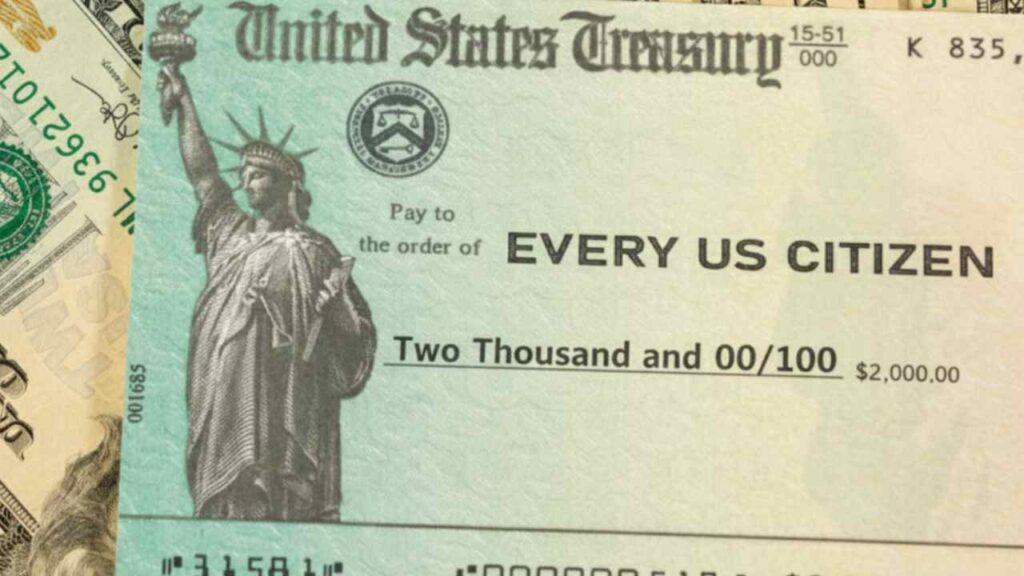
Against this backdrop, a new policy proposal has captured attention: the $2,000 “tariff dividend” promised by President Donald Trump, which claims it would be financed by tariff revenue rather than new debt.
No Federal Checks on the Horizon for December: What About the $2,000?
Contrary to misinformation circulating on social media, the IRS has not announced or confirmed the issuance of stimulus payments for the final weeks of 2025. Any such program would first require approval through new legislation from Congress… a step that has not been taken.
The most recent IRS activity on this front ended in the spring of 2025. Between December 2024 and January 2025, the agency issued automatic payments to roughly 1 million taxpayers who had not claimed the “Recovery Rebate Credit” for the third 2021 stimulus payment of up to $1,400 per person. The window to claim that credit closed definitively on April 15, 2025, with no extensions available.
The “Tariff Dividend” Proposal: Promises and Red Ink
Discussion of new direct payments has been reignited by a proposal from President Trump. On his social media platform, he has promised to send “a dividend of at least $2,000 per person (high earners excluded!)“, asserting that tariffs on imports are generating record revenue to make it possible.
Treasury Secretary Scott Bessent has suggested payments could be limited to individuals or families earning under $100,000, though he clarified that details—even the form of the benefit (direct checks or tax cuts)—are still being debated.
Economic analysts and budget experts have scrutinized the idea’s feasibility, and their conclusions are uniformly skeptical. A Tax Foundation study modeled various designs for the $2,000 payment, estimating the total cost would range from $279.8 billion to $606.8 billion.
Stimulus Checks: Estimated Cost vs. Tariff Revenue
| $2,000 Payment Scenario | Estimated Cost (Billions) | Tariff Revenue (2025) |
|---|---|---|
| Option 1: Cutoff at $100k for all | $279.8 | |
| Option 3: With phase-out (similar to pandemic checks) | $606.8 | $158.4 Billion |
| Total Tariff Revenue (2025-2026) | $365.9 Billion |
The core problem, some analysts say, is that the cost of the checks would far exceed new tariff income. Even under the most economical scenario, the cost would consume all expected tariff revenue for 2025 and a significant portion of 2026’s. TD Economics agrees, estimating a program targeted at low- and middle-income households would cost about $250 billion, wiping out most of next year’s tariff income.
Stimulus Checks: Two Radically Different Funding Philosophies
First, let’s see the Pandemic Stimulus (2020-2021): Debt-Financed. The three Economic Impact Payments (up to $1,200, $600, and $1,400) were passed by Congress as emergency spending to sustain the economy during COVID-19 lockdowns. These payments, which totaled hundreds of billions of dollars, were financed primarily by increasing the federal deficit. They were an exceptional response to an exceptional crisis.
Now, the Tariff Dividend Proposal: A Promise of Self-Funding. The current administration argues the payments would not add to debt but would be paid for by tax revenue from tariffs on imports. However, as the analyses show, this promise of self-funding is mathematically difficult to fulfill at the proposed payment scale. Experts like Erica York of the Tax Foundation conclude that “under nearly any design option, sending $2,000 payments to Americans would increase, not decrease, the federal budget deficit.”
Secretary Bessent has acknowledged any direct payment program would require approval from Congress. Currently, there is little appetite among legislators, including deficit-wary Republican allies, to pass massive new spending.