
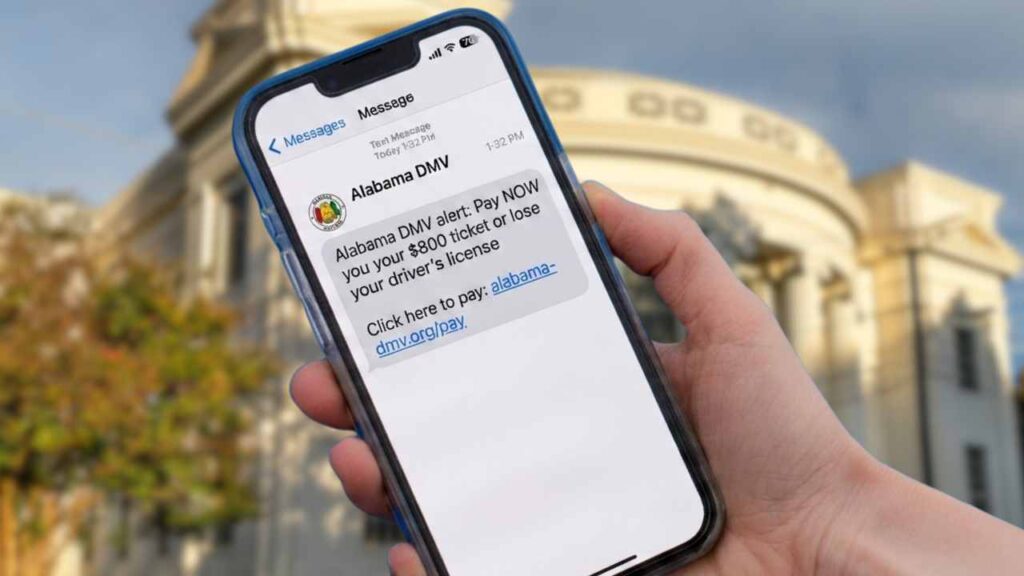
Officials across Alabama are warning people about a text message scam that’s gotten so convincing it’s clogged courthouse phone lines and left thousands of drivers panicked that they’re about to lose their driver’s license. The whole scheme has one glaring hole: it name-drops a government agency that doesn’t exist: the Alabama Department of Vehicles (DMV).
The texts come out of nowhere, often with the recipient’s name right there in the message, threatening fast and serious consequences for an unpaid traffic ticket the person never even heard about. Suspension of your driving privileges. Damage to your credit. Legal action. A 35-day countdown clock.
Alabama DMV? If you take a closer look, it all falls apart
The wording is cold and bureaucratic — exactly what you’d expect from an official notice. Some versions even include an attachment that looks like a formal document with the state of Alabama seal and a header that says “Final Notice.”
The agency name stamped on the notice is the “Alabama Department of Vehicles,” or sometimes just “Alabama DMV.” Neither one is real. In Alabama, driver licenses are handled by the Alabama Law Enforcement Agency’s Driver License Division — ALEA for short.
Vehicle registration is done through the Alabama Department of Revenue. There is no DMV in this state. Scammers apparently grabbed a name most Americans recognize from other states and slapped it onto fake paperwork aimed at Alabamians.
Different Versions of the “Alabama DMV” Scam
Some versions of the attached document carry a second mistake investigators flagged right away. It claims to come from the “Municipal Court of St. Louis County.” There’s no St. Louis County in Alabama.
The address listed in the notice points to a location in Missouri. Investigators say mismatches like that are among the most obvious signs the document is fabricated, but the sheer urgency baked into the message makes a lot of people skip right past them.
Officials in Shelby County dug into one of the links embedded in a version of the scam and traced it back to a domain registered to a company in China. The address had no connection to any Alabama government office or county authority.
Warning: Don’t Click or Respond to the Scams
The Alabama Law Enforcement Agency was one of the first to put out a public warning, and Secretary Hal Taylor didn’t mince words. “Scammers are trying to create a false sense of urgency by threatening you and your driving privileges,” Taylor said. “We urge all Alabamians to be cautious and remember that our Agency will never contact you this way.”
The Alabama Department of Revenue followed up with an equally blunt statement. “ALDOR does not enforce traffic laws or penalize people for unpaid tickets,” they said. “Also be aware that an ‘Alabama Department of Vehicles’ does not actually exist.”
Fake Alers for Driver’s Licenses Holders
The Albertville Police Department took it a step further in a social media post that got shared a lot. “These notices are NOT legitimate,” the department wrote. “They are designed to scare you into paying money or giving away personal information.”
In Tuscaloosa, the impact hit hard and fast. Jessica Steward, who runs the city’s municipal court, said her office fielded more than 50 calls in a single day from residents who were convinced they had outstanding tickets. “We’re getting a lot of calls now,” Steward said.
“We got over 50 calls yesterday for people thinking they had tickets in this court that are outstanding. Most are not, but with those text messages going out, it’s very generic.” She explained that the messages reference an Alabama code section but contain nothing tailored to the person at all — a classic sign of a mass phishing operation. “It references some Alabama code section, but it has no information for the individual,” Steward added.
DMV Scams Happening in Several States
The scam isn’t just happening in Alabama. Investigators say the operation is national in scale. The messages adapt to whatever state the target lives in, swapping out the Alabama references for whatever jurisdiction fits. The mechanics stay identical. Only the branding changes.
Law enforcement agencies across the board are giving the same advice. Don’t click any link in an unsolicited text that claims to be from a government office. Don’t call any numbers included in those messages. Don’t hand over financial or personal details. If you get one of these texts, delete it, mark it as spam through your phone’s messaging app, and file a report with the Federal Trade Commission or the Internet Crime Complaint Center.